October 2026
By Pattie Magee
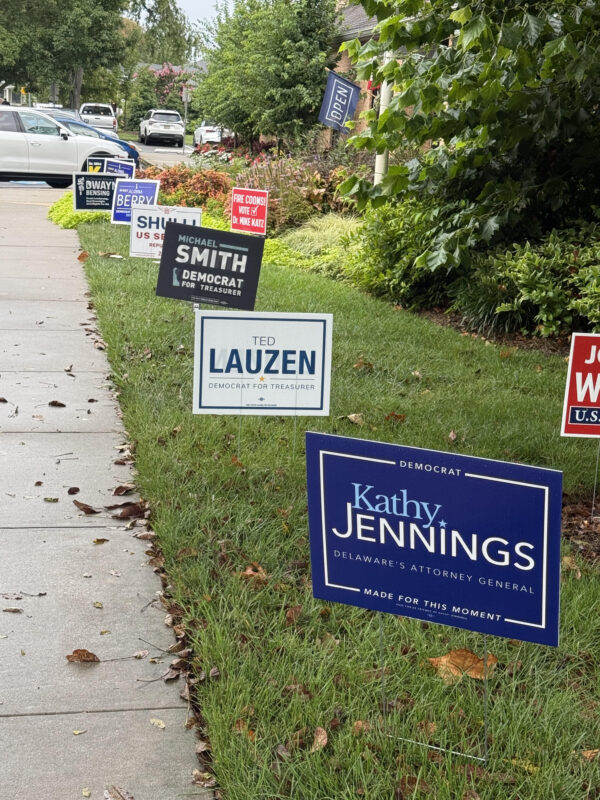 Why are there so many corrugated plastic rectangles – vibrant blues, stark reds, bright whites – showing up all over the state like flowers popping up on the side of the road? It’s campaign season and Delaware’s roadways are undergoing a colorful transformation.
Candidates local to Sussex County and statewide want to get their name and the office for which they are running in front of people. Of course, they have online and newspaper advertisements, public rallies, literature in mailboxes, but that big sign on the side of the road is another story.
Nearly every state and municipal government in the United States restricts where, when, and how campaign signs can be displayed in order to maintain road safety, prevent litter, and regulate electioneering near polling locations. Campaign signs in Delaware are governed by a strict set of guidelines enforced by the Delaware Department of Transportation (DelDOT).
Ground Rules
Signs are not permitted on the State’s Right of Way, aka the “Clear Zone.” Signs cannot be placed on highway medians, traffic islands, the triangular strip of land between roads and exit ramps, or on utility poles. Signs must be placed 10 feet from the edge of the pavement and can never be placed on private property without the permission of the owner.
Signs are permitted for 30 days before and 30 days after an election, except in Sussex County, which allows signs to be placed 90 days before an election.
Sussex County also dictates the size and nature of the signs. No sign can exceed 32 square feet per sign face and can contain no more than two sign faces, back to back.
DelDOT has jurisdiction over these regulations and may remove any signs that are out of compliance, routing them to what campaigns refer to as “sign jail.” Getting a sign out of jail costs $25 for the violation plus a $15 recovery fee. In highly competitive cycles, DelDOT has issued thousands of violations, racking up tens of thousands of dollars in fines for sloppy placement.
Strategy Behind the Signs
So why put up campaign signs in the first place? One of my favorite political gurus always tells me, “Signs don’t vote, people vote.” While this is true, signs are a key element of voter outreach through name recognition. Repeated exposure to a candidate’s name prompts voters to seek out their website and platform online. Name familiarity increases the engagement and effectiveness of the campaign’s broader media efforts, including print, digital, and direct mail advertising.
Effective placement is crucial. Intersections are prime locations because stopped traffic or vehicles slowing to turn gives drivers time to read the message, whereas signs placed along roadways where drivers are whizzing by offer little visibility.
Some believe that large signs are more effective. This is not necessarily so. There are those who do not believe in signs at all stating that they clutter the environment. This is very true. However, if a candidate has no signs and their competition does, voters may start to wonder about this candidate’s commitment to the race.
Sign design is an important consideration. Bold, clear eye-catching colors are best. The candidate’s name, the office for which they are running and their party affiliation should be clearly printed on the sign. Many candidates place a picture of themselves on the sign. Each sign must identify the source of funds used for it.
Since there are very specific rules about where signs can be placed, it is important to control the number of people who are putting them out. These designated sign volunteers should be carefully chosen and trained.
A list of every sign location is kept so all can be taken down at the end of the campaign. Candidates never want to incur fines for breaking the rules.
Post-Election Clean-Up
Campaigns have exactly 30 days to clean up their footprints. After that, DelDOT resumes enforcement, guaranteeing the landscape is clear again.
Pattie Magee is a life-long educator who worked in Kentucky, Texas, Pennsylvania and Delaware as a teacher, special education supervisor, and school principal. She has been a member of RD 14 for twelve years. During nine years as chair of the Get Out The Vote (GOTV) committee, she has planted hundreds of campaign signs throughout RD 14 and none of them landed her in jail.
Two Sidebars:
#1
To see how strictly these rules are enforced, consider a volunteer who spent an entire Saturday morning carefully placing campaign signs at a busy intersection near a new housing development. Wanting maximum visibility, the volunteer pushed the stakes right up to the curb. By Monday morning, every sign was gone. Because the signs were placed within the restricted 10-foot Clear Zone, they were flagged as a safety hazard and immediately removed. The campaign had to pay a fine to get them back.
#2
In one of the state’s most infamous campaign sign scandals, the husband of a sitting Delaware state senator was caught on camera swiping rival campaign signs in the middle of the night along State Route 299 in Middletown. Frustrated after dozens of their advertisements vanished over several nights, volunteers for the opponent set up a stakeout and captured the midnight heist on cellphone video. The incident resulted in a police investigation, misdemeanor theft charges, and a flurry of statewide headlines.