
October 2026
By Carole Jesiolowski
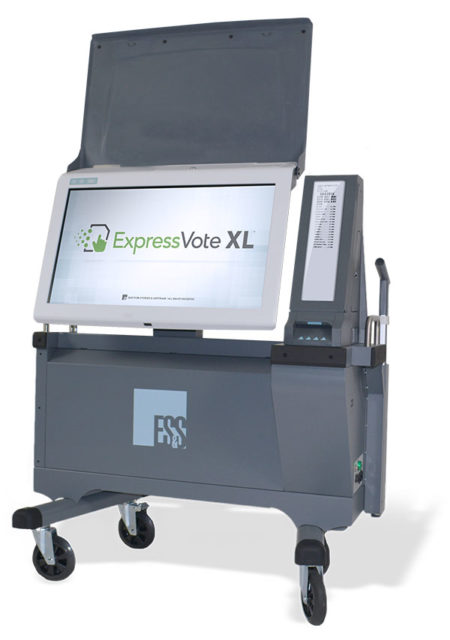 If you have ever wondered what actually happens behind the sleek glass screen of the voting machines at your local polling place, or where your ballot goes after you hit “confirm,” the process is a lot more fascinating (and secure) than you might think.
For voters in Delaware, casting a ballot blends modern technology with a reassuringly old-school paper trail. After a multi-year study to replace the machines in use since 1996 (at the time the oldest in the nation), the state began to roll out a fleet of ES&S ExpressVote XL systems starting with the May 2019 school elections. It took until 2022 for the machines to be in use at every voting location for every election.
These towering 32-inch touchscreen monoliths look less like traditional government hardware and more like a high-stakes arcade game where the prize is democracy.
How the Process Works
The Delaware Department of Elections engineered a user-friendly system to guide voters smoothly from check-in to checkout. The process unfolds in four steps:
- Activation Card: After verifying your identity with poll workers, you get a paper activation card to slot into the machine to jumpstart your session.
- Selection: The massive screen displays the full ballot on a single face. You make your selections by tapping the screen, which is significantly easier than choosing a streaming show on a Friday night.
- Paper Review: Before anything is officially recorded, the machine prints your choices onto a paper ballot behind a transparent window. This allows you to verify that the machine correctly understood your intent and didn’t accidentally mistake your vote for an entirely different choice.
- Tabulation: Once you tap the final confirmation button, the machine pulls the paper ballot into a secure internal container, officially digitizing and recording your vote.
Security Layers (Or, Why Hackers Hate Delaware)
A foundational rule of election infrastructure is that voting machines are entirely offline. The units do not have internet modems, Wi-Fi capabilities, or any connection to the outside world. Attempting to hack a Delaware voting machine from a remote location is functionally equivalent to trying to Bluetooth-pair your phone with a toaster oven—there is simply no signal to catch.
Furthermore, the system relies on redundant safety nets. It records votes using distinct electronic memory components while simultaneously storing the physical, voter-verified paper records inside a heavy, locked canister on the back of the machine. If a dispute ever arises or a recount is triggered, election officials don’t just rely on the computer’s memory; they go directly to the physical paper trail to manually verify the tallies.
After-Hours Escort (What Happens at 8:01 PM)
Once the polls officially close, the real-world logistics kick off like a coordinated security detail. Election Officers detach the secure card containers—the heavy canisters holding the physical ballots—from the back of each machine. The polling place inspector takes personal custody of these bins and drives them straight to the Department of Elections County Office warehouse. RD 14’s go to Georgetown.
From there, authorized staff move them into a secure, 24/7 physically and electronically surveilled repository within the building. Designated state authorities, such as the Board of Canvass, systematically cross-reference the machine records and physical paper backups before certifying the final outcome. Once everything is certified, these paper ballots are sealed tight in tamper-evident deposit bags and locked away undisturbed: 22 months for state elections and five years for school elections.
Tale of the Thumb Drive
In addition to the paper ballots, each vote is recorded and stored on the Elections Media Stick, unique to each voting machine. This thumb drive is secured inside a locked compartment on the machine. At closing time, officers unlock the compartment, remove the stick, and seal it inside a zippered pouch with a unique security seal number recorded on official documentation.
The Inspector hands this pouch over to one of the polling place Election Officers who is now designated as Elections Media Clerk. This clerk’s sole job is to leave the polling place and deliver that pouch directly into the hands of authorized, badged Department of Elections staff at a secure collection station in the Department of Elections County Office. No stops for fast food, no detours.
All-Day Security Patrols
Throughout Election Day, the Department of Elections deploys teams of pre-cleared, badged agents who act as roving tech security. They swing by polling places all day long to inspect the machines, check the secure card containers for any signs of tampering, and double-check that the thumb drive compartments are locked tight.
If a voting machine gets popular and its secure card container reaches maximum capacity, Election Officers call headquarters, and an authorized agent arrives with a fresh, sealed, empty replacement bin to swap out on the back of the machine. The full bin is immediately carted off to the high-security warehouse at the Department of Elections County Office.
By combining physical locks, bipartisan handlers, strict chain-of-custody tracking, and a total lack of internet access, Delaware ensures that by the time election results are finalized, the process is as airtight as it gets.
Carole Jesiolowski is the editor of The Voice. Prior to her move to Lewes, she was president of Social Business LLC and senior vice president and managing editor at Data Key Communications Inc., both located in Syracuse, NY.