
September 2026
By Representative Claire Snyder-Hall
People sometimes make the mistake of falling into silo thinking, an approach that views state politics as somehow isolated from national politics, or they think the local party and candidates for the state legislature should only focus on state issues. I have found, however, from knocking on thousands of doors, that voters in RD14, and I am sure everywhere, are very much focused on national issues. And they should be, because national issues directly affect us.
This past session, my first in office, Delaware elected officials had to respond to a large number of Trump-produced problems: funding cuts, the government shutdown, ICE abductions, meddling in our schools and hospitals, et cetera.
But state elected officials can do more than just play defense. We can also lend our support to efforts in Congress to pass laws that will affect us all. And those of us in the General Assembly can let our Congressional delegation know what the people we represent want.
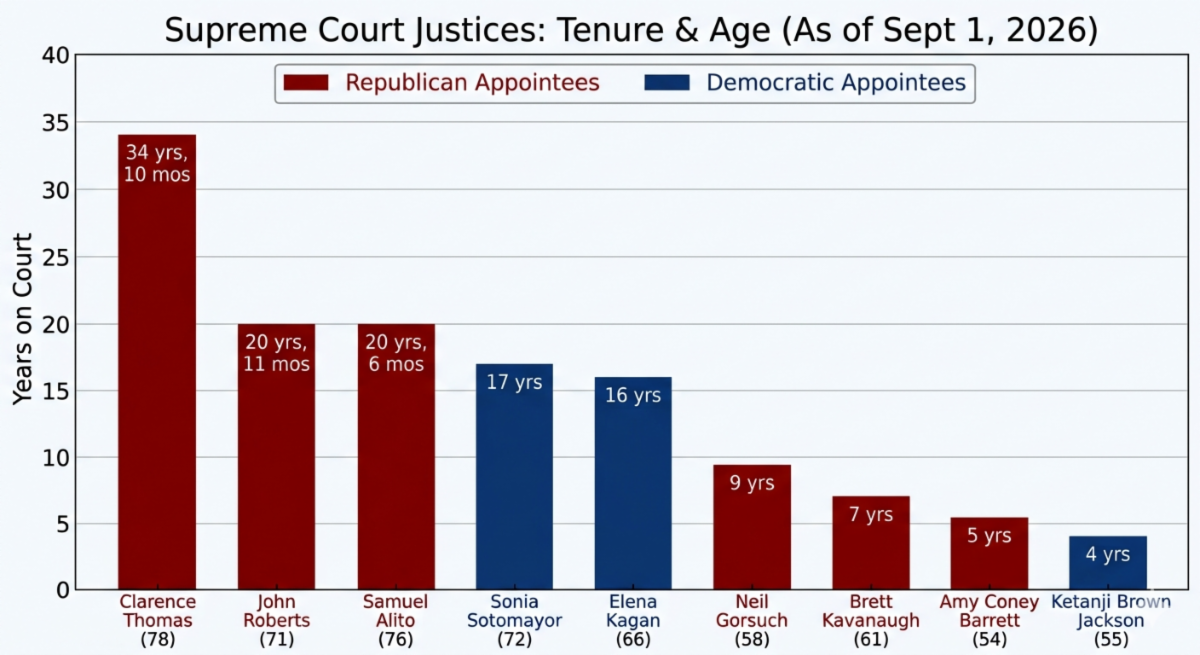
That is why I am working with the Brennan Center for Justice – via a former colleague from my Common Cause days – to get my current colleagues in the General Assembly to support 18-year term limits for active service on the U.S. Supreme Court.
Activist Democrats, such as those reading this newsletter, are well aware of the problems with the current Supreme Court. Indeed, even non-activists are aware. That’s why the public overwhelmingly supports term limits for Supreme Court justices – 78% in a recent Fox News poll, including 68% of Republicans. The idea also has strong support from constitutional scholars and former judges.
At a time when public approval of the Court is hovering at historic lows, Congress must act to tighten the democratic link between the Court and the people it serves.
To meet that goal and restore balance to our constitutional system, Congress must reform the Supreme Court, starting by replacing lifetime appointments with 18-year term limits for the justices. Such a system would allow each president to appoint two (and only two) justices to the Court per term, giving presidents an equal opportunity to shape the bench.
Unbounded tenure allows a single justice to shape the direction of the law for generations. Term limits will ensure that no single justice has too much power for too long. Consider Justice Scalia who served 30 years and died in office at the age of 79, or Ruth Bader Ginsberg who stayed in office so long that President Obama missed his chance to replace her.
Term limits will also promote regular turnover on the bench, creating more opportunities to bring new voices and viewpoints to the Court and lower the stakes and political intensity of the confirmation process for the justices.
Of note, no other major democracy in the world gives lifetime seats to judges who sit on constitutional courts, and 49 out of 50 state supreme courts in the United States do not provide lifetime appointments for their justices.
The Supreme Court has vast power but limited accountability. That is why I will be calling on my colleagues in the General Assembly to support the establishment of term limits for justices of the United States Supreme Court.
Claire Snyder-Hall is the State Representative for the 14th Representative District. Prior to her election to the General Assembly in 2024, she led the Delaware Office of Common Cause, and has held a range of leadership positions within the Democratic Party. She holds a PhD in political science and is the author of three books and dozens of articles.
Delaware’s Judicial Term Limits
Delaware’s five Supreme Court justices, ranging in age from 46 to 69, are appointed for a fixed 12-year term. They can be reappointed again after their 12-year term expires because Delaware does not have judicial term limits or a mandatory retirement age. To secure another term, a sitting judge must formally apply to Delaware’s Judicial Nominating Commission for reappointment. Chief Justice Collins J. Seitz Jr. is the only justice on the current court serving beyond an initial 12-year cycle. He was first appointed as an Associate Justice in 2015, then sworn in as Chief Justice for a new 12-year term in 2019.
Learn more about Delaware’s Court system at courts.delaware.gov